
You’ve Had Chocolate, But Have You Met Ceremonial Cacao?
There is a difference between something you consume — and something you commune with.

There is something humanity has known for thousands of years that got lost somewhere between the Industrial Revolution and a candy aisle. The cacao bean — yes, the very one your chocolate came from.
It was never meant to be sweet.
It is medicine.
It is ceremony.
It is sacred.
Somewhere along the way, we added sugar, stripped out the fat, mixed in milk powder, wrapped it in foil, and called it a treat. And look, no judgment from my side. Chocolate is delicious. But ceremonial cacao is something else entirely.
This guide covers everything: what ceremonial cacao actually is, how it differs from chocolate and cocoa, what it does in the body, its ancient history, what happens in a cacao ceremony, and how to find the real thing. By the end, you’ll know more about this plant than most people who’ve been eating chocolate for years.
What Is Ceremonial Cacao?
Ceremonial cacao is made from pure, heirloom cacao beans; the kind grown in biodiverse soil close to the equator. Typically grown in Guatemala, Peru, Ecuador or Bali. The beans are fermented to develop flavour complexity. It’s sun-dried, lightly roasted or sometimes left completely raw, then stone-ground into a thick paste and pressed into blocks or disks.
That is the entire ingredient list.
No sugar. No milk powder. No emulsifiers. No “natural flavours” that are anything but. Just the whole bean, including all of its cacao butter, preserved in its complete form.
When you shave off a chunk and melt it into hot water, you are literally drinking the entire plant. Every fat, every mineral, every bioactive compound, intact. That matters more than it sounds.
Ceremonial Cacao vs Chocolate vs Hot Chocolate
This is the part that changes things for most people, because these three are not nearly the same.
Most commercial chocolate is heavily processed, high in sugar, often contains dairy, and has been stripped of much of its original plant complexity. Even dark chocolate, while better, is still processed and diluted. Hot chocolate takes this further. It’s typically cocoa powder (which has had the cacao butter removed), mixed with sugar and milk.
It’s comfort. It’s cozy. It’s dessert. But it’s not sacred medicine.
Ceremonial cacao is whole-bean, naturally high in fat from its preserved cacao butter, bitter, earthy, and rich. It’s consumed intentionally. It’s closer to drinking a plant infusion than a sweet beverage, and it asks for presence in a way that a mug of hot chocolate simply doesn’t.
If chocolate is a pop song and hot chocolate is a lullaby, ceremonial cacao is a whole album. One you sit and listen to in the dark, while deeply feeling each lyric.
The Health Benefits of Ceremonial Cacao
Cacao is one of the most biochemically complex plants humans consume. Here is what you are actually drinking when you drink it ceremonially.
- Theobromine is a gentle cardiovascular stimulant, but nothing like caffeine. Instead of wiring your nervous system, theobromine stimulates the heart and opens blood flow. The energy it creates is smooth and sustained, with no spike and no crash. You don’t feel jittery. You feel expansive. The emotional quality people describe — a warmth in the chest, a sense of openness — is an experiential response that many attribute to this shift in circulation and heart rate. It is felt, not manufactured.
- Cacao is one of the richest plant sources of magnesium on the planet. Magnesium contributes to muscle relaxation, nervous system regulation, emotional balance, sleep quality, and PMS relief. A ceremonial serving delivers a meaningful amount, and your body tends to notice.
- Anandamide is often called the “bliss molecule,” and yes, that is a real thing. Anandamide is produced naturally in the brain and interacts with the same receptors as cannabis. Not to produce intoxication, but to support feelings of wellbeing and ease. Researchers believe cacao also contains compounds that slow the breakdown of anandamide in the body, meaning you may stay in that open, softened state for longer. That heart-expanding feeling people describe in ceremony is thought to be, at least in part, why.
- Cacao is also exceptionally high in flavonoids which is a powerful antioxidant. It reduces inflammation, improves blood flow, and brain and cardiovascular health. The kind of thing your body quietly thanks you for.
Unlike caffeine, theobromine stimulates the heart more than the nervous system.
You don’t feel wired.
You feel open.
The Ancient History of Cacao
Cacao was revered by the Maya and Aztec civilisations, not as a treat, but as a bridge between worlds. It was used in rituals, consumed by warriors before battle, offered to deities, drunk during rites of passage, and exchanged as currency. Entire ceremonial frameworks were built around this plant. They knew something.
To drink cacao ceremonially today is to stand in a lineage that belongs to Mesoamerican peoples, and to hold that with acknowledgement and respect.
What modern science is now confirming is what these cultures experienced empirically for thousands of years: cacao shifts something in the body.
It opens the chest.
It softens the guard.
It brings what is buried a little closer to the surface — gently, safely, without overwhelm.
Unlike psychedelics, cacao doesn’t overpower you or hijack your consciousness. It works with you, not on you. It amplifies what’s already present.
If your heart is guarded, you may feel the guard.
If grief is near the surface, it may soften.
If joy is ready, it tends to bloom quickly.
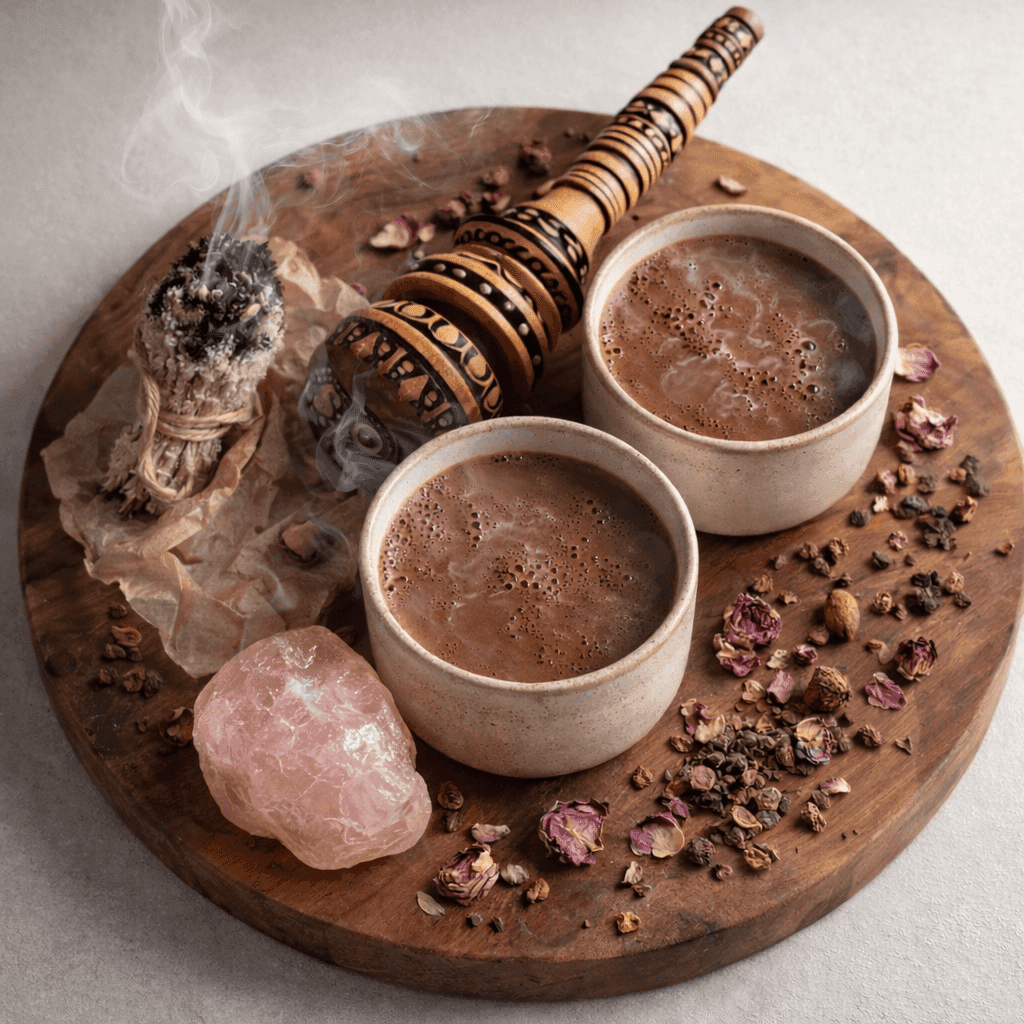
What Does Ceremonial Cacao Taste Like?
If you’re expecting Swiss chocolate sweetness, you will be gently humbled.
Ceremonial cacao is bitter, deep, earthy, slightly smoky, and nutty — sometimes fruity depending on the origin of the bean. It’s thick and velvety. Almost like drinking warm delicious liquid soil, which sounds strange until you taste it and realise it feels like being held by something very ancient.
Many people add cinnamon, cayenne, a pinch of sea salt, or a touch of raw honey. Traditionally though, it was consumed bitter. Because bitterness awakens. And awakening is the whole point.
What Happens in a Cacao Ceremony?
A cacao ceremony isn’t about theatrics or woo-adjacent mysticism. At its core, it’s a structured container for intentional inner work, held with cacao as the sacred focal point.
It typically begins with intention setting: arriving with a question, a grief, a desire, or simply an openness. The cacao is prepared slowly and mindfully, because the act of preparation is already part of the medicine. It’s drunk together in silence or with music, seated, feeling the warmth move through the body. What follows — meditation, breathwork, journaling, somatic work, sharing, movement, or pure stillness. It all depends on the facilitator, collective intention and the group.
Physiologically, your heart rate increases slightly from the theobromine. Blood flow improves. Emotional processing becomes more accessible. People often describe increased compassion, emotional release, heightened intuition, and a felt sense of connection — to themselves and to the people around them.
Is that “woo”? Consider this: you have a bioactive plant, group coherence, nervous system regulation, shared intention, and ritual structure, all working simultaneously. Humans have been using exactly this combination to alter states of connection for thousands of years. We just have the science now to explain some of the why.
Who Is a Cacao Ceremony For?
Honestly? Anyone who is ready to slow down and feel something real.
People come to cacao ceremony at all kinds of thresholds — a career transition, the end of a relationship, a grief that hasn’t had space yet, creative stagnation, burnout, or simply a quiet knowing that something needs to shift. Others come out of pure curiosity, with no particular story, just an instinct that this is something worth experiencing.
You don’t need a spiritual background.
You don’t need to know anything about plant medicine.
You don’t need to have been through something dramatic.
Cacao meets you wherever you are — and that tends to be exactly the right place to begin.

How to Find Genuine Ceremonial Grade Cacao
Not everything labeled “ceremonial cacao” actually is. The wellness market caught on quickly, and with it came a flood of products that are ceremonial in name only. It tends to be processed, diluted, or missing the one thing that makes cacao what it is: wholeness.
The real thing will tell you. Look for heirloom bean varieties — Criollo or Nacional specifically. These are traditional, less commercially grown varieties with deeper flavour and higher bioactive content. A trustworthy supplier names the farm, region, or cooperative. “Sourced from Central America” is vague, compared to “Criollo beans from the Polochic Valley, Guatemala”.
The ingredient list should be one word: cacao. And if it dissolves instantly in water like a powder, the fat has been removed — what you’re holding is cocoa, not cacao. Genuine ceremonial grade is thick, bitter, and complex. If it tastes like mild chocolate, something was added or taken away.
Is Ceremonial Cacao Safe?
Cacao is gentle, but it is real medicine — and real medicine asks for some awareness. It is not recommended in high doses for people on certain antidepressants, particularly MAOIs. Those with serious heart conditions, who are pregnant, or who are on stimulant medications should consult a healthcare provider before attending. A ceremonial dose is typically 20–40g depending on the intention and the person. More is not deeper. Depth comes from presence, not quantity.
The Thing Nobody Tells You
Ceremonial cacao is not powerful because it’s magical in some abstract sense. It’s powerful because it is whole.
Whole bean.
Whole chemistry.
Whole heart.
It doesn’t numb you. It doesn’t spike you. It doesn’t distract you. In a culture addicted to dissociation, cacao gently invites you back into yourself. Without asking you to perform a breakthrough or arrive anywhere other than where you already are.
And that, somehow, ends up being the most radical thing of all.
Experience a Cacao Ceremony in Somerset West & Cape Town
Sacred Perpetuity hosts intimate cacao ceremonies in Somerset West, Cape Town. Each ceremony is a small, intentional container — held with care, with presence, and with genuine ceremonial grade cacao. Our ceremonies are accompanied by a sacred tea blend of blue lotus, reishi, rooibos, and raw honey, prepared alongside the cacao to deepen the experience of opening and grounding.
Whether you are arriving with something to release, something to seek, or simply a willingness to be still — there is space for you here.
View my upcoming ceremonies and reserve your seat at https://sacredperpetuity.co.za/upcoming-ceremonies-events/
Visit my Website: https://sacredperpetuity.co.za/ Explore my offerings: https://sacredperpetuity.co.za/offerings/ Instagram: https://www.instagram.com/sacredperpetuity/


